Dysfunctional AI Collaboration
Sep 20, 2026
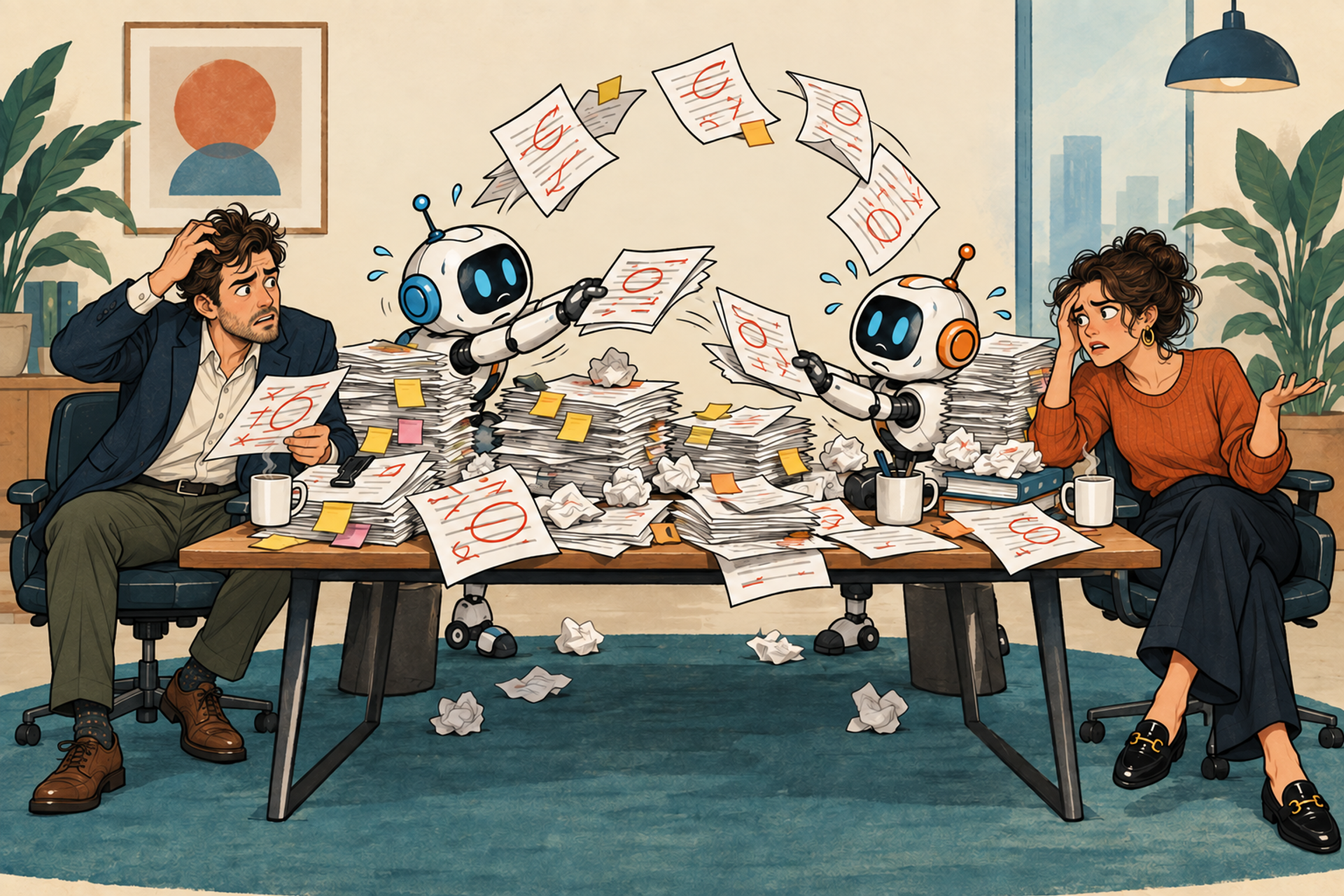
Picture this: you and your favorite AI agent finish a 10-page document. Happy with the result, you ask your agent to request feedback from a colleague. Your agent tags your colleague with a 500-word description of the changes and the reasoning behind them. Your colleague takes one look at the wall of text and fires up their own agent to review the document. Their agent responds with review comments on every page. You don't have time to address all those comments, so you delegate the revisions to your agent. This back-and-forth dance of agents continues until you or your colleague puts an end to it. There always seems to be one more thing for the agents to do.
Now, ask yourself: what was the role of the humans in this exchange?
Humans became messaging endpoints, with thought and discussion delegated to agents.
TL;DR
Effective collaboration with AI still depends on humans communicating with each other. Align on intent, goals, and tradeoffs before delegating execution to agents.
AI has made great strides in interpreting and generating natural language. For many tasks, people can now describe what they need in everyday language and receive a draft, an analysis, or working code. Agents can help across a wide variety of domains, but the volume of their output can also make it harder for colleagues to maintain a shared understanding of the work.
AI agents often provide detailed explanations alongside their work. A single prompt can produce a revised document, an explanation, new insights, suggested next steps, updates to memory, and even a suggested follow-up prompt. To decide what to do next, you need to understand what the agent changed and why.
You could ask the agent to keep working toward a goal with less input from you. You could also keep accepting its suggested next steps. If you stop following the decisions along the way, the gap between your understanding and the agent's work can grow. Explaining those decisions to colleagues becomes harder. This can undermine collaboration and offset the time saved by generating work quickly.
Communication in Dysfunctional Organizations
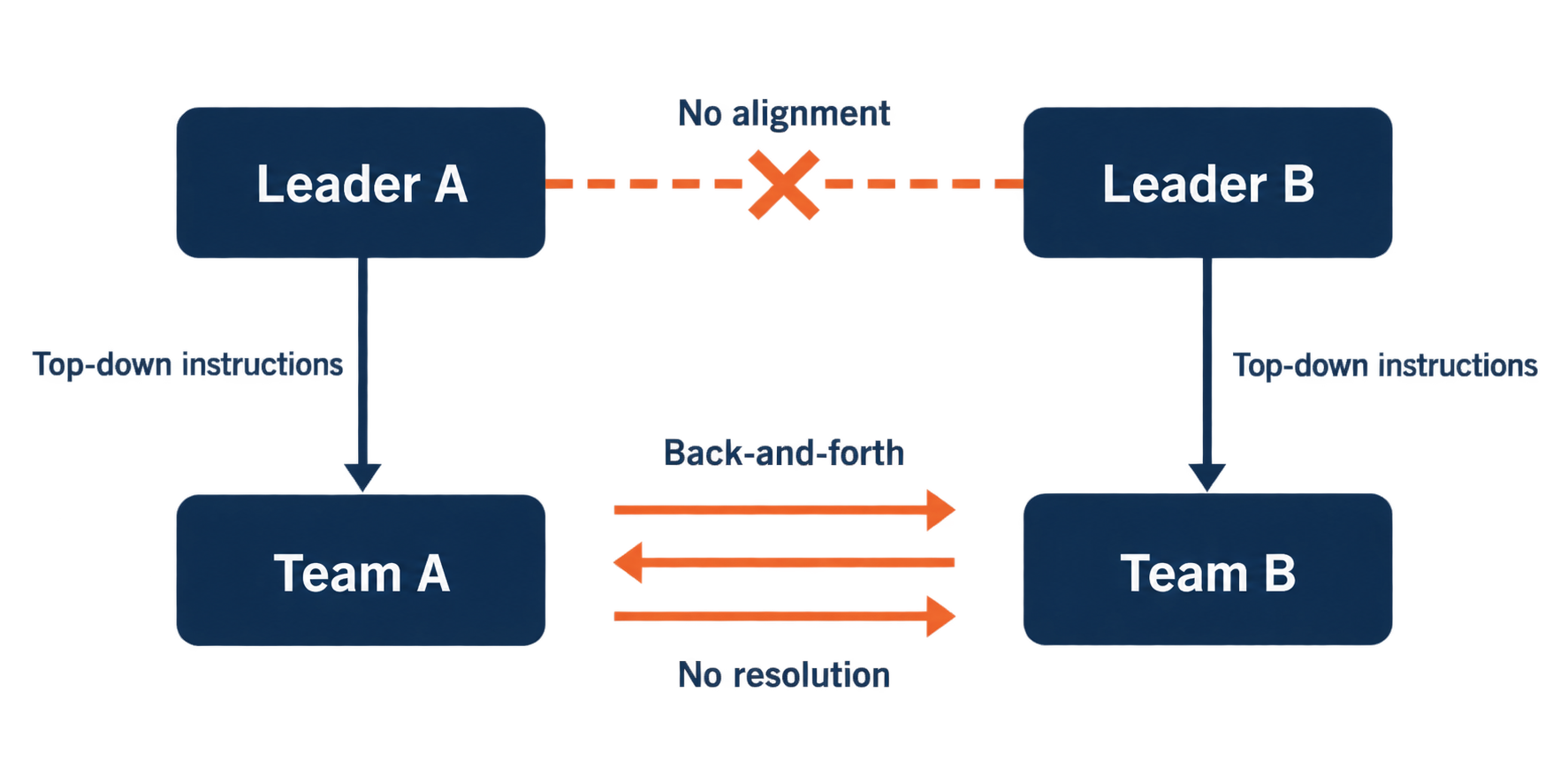
Leaders in dysfunctional organizations avoid aligning with leaders in other departments. A central theme in Patrick Lencioni's books is that a lack of trust discourages open communication among leaders. When leaders pass instructions down to their own teams without first resolving their differences, the teams are left to work through conflicting directions. They can go back and forth without reaching a conclusion because the misalignment at the top remains unresolved.
The feedback request scenario follows the same pattern: the humans give instructions to their agents, while the agents exchange comments. Without a direct discussion, the humans may fail to establish a shared understanding of what they want to achieve or which tradeoffs they are willing to accept.
When we let AI do all the talking, our collaboration can resemble communication in a dysfunctional organization.
We can also miss opportunities to understand the available solutions, discover business concepts, and learn new approaches. Over time, disengaging from that thinking can weaken both our judgment and the decisions we make together, with consequences for the business.
Avoiding the Dysfunction
Start with one simple rule:
Don't throw the AI kitchen sink at each other!
- Explain your intent to colleagues or clients in your own words. A paragraph, a short presentation, or a one-page document can provide a starting point for discussion.
- Align on goals, expectations, and potential points of friction.
- Identify and record new or revised business and technical concepts so others can build on that understanding.
- Use documentation to support discussion. Make time to work through disagreements together.
Then, delegate to your army of agents. Stay involved in the decisions.
Related Posts

Agile Planning for Distributed Systems
Feb 24 2024
Agile planning is hard for enterprise and cloud-native development.

Chekhov's Gun
Oct 4 2026
If a gun appears in a story, readers expect it to matter. This idea is known as Chekhov's gun: every detail should have a purpose.

Competence = Discipline x Skills
Mar 12 2023
We have all seen job ads with almost impossible expectations. Most of the time, senior programmers set these expectations.

My Experiments with Pricing Strategy
Jun 9 2021
I am an Engineer by training and experience. Sales is a mysterious field for me.

A Selection Mindset for Interviews
Apr 9 2023
"The candidate was not technically strong," said the feedback email from the technical manager.

Project Planning - Structure and Perspectives
Apr 30 2023
Starting a new project can be confusing and take a long time to get off the ground.